


Two Years On
A Time of Reckoning
BY RABBI DORON PEREZ
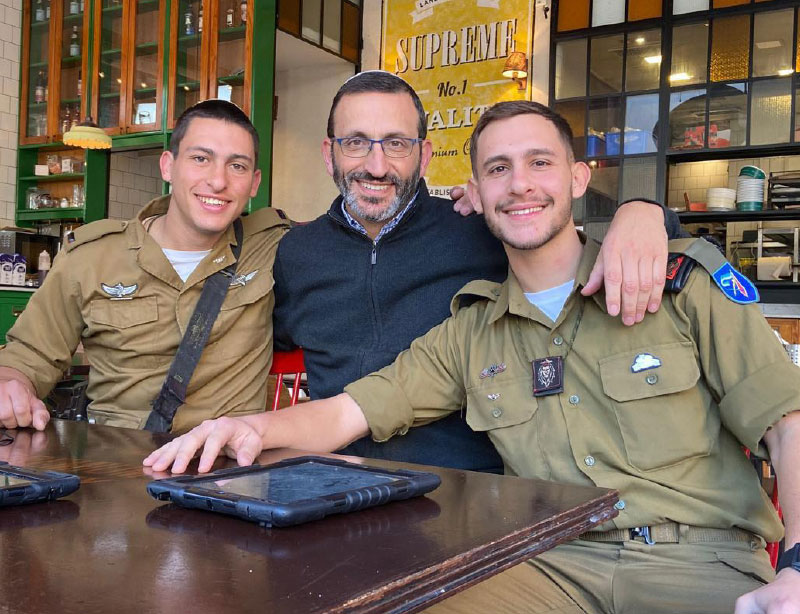
The last time I saw our two boys together, Yonatan and Daniel, was on Rosh Hashanah 2023, exactly two years ago. Both were then serving in the permanent force of the Israeli army – Yonatan as a company commander in the paratroopers, and Daniel as an officer and tank commander in the tank corps.
Thankfully, they were both home for Rosh Hashanah with us in Yad Binyamin. How wonderful it was to be flanked by them during the davening over these two days. Little did I know this would be the last time I would be with them together again.
On Yom Kippur, they were both back in the army. On the first day of Sukkot, Daniel was with us while Yonatan was on duty. And on Simchat Torah, Daniel was positioned with his tank crew on the Gazan border, while Yonatan was with us at home with his then-fiancée Galya, ten days before he was to be married.
It was painfully decreed on that Rosh Hashanah and sealed on Yom Kippur that this would be Daniel’s last. He would fall with crew members Itay Chen and Tomer Leibowitz, after two hours and sixteen minutes of great bravery in his tank’s heroic battle. Matan Angrest was wounded and taken hostage alive, while the bodies of Daniel and Itay were taken to Gaza, where they all remain today, as of the writing of these lines.
The time of the Yamim Nora’im, the High Holy Days, is always one of intensity and has never been more painful and poignant for me than since October 7th. It is a time not only for deep introspection on a personal level, but also on a collective level – especially so now, as we approach the second anniversary of this protracted war. It is a time to reflect on all that has been lost and all that has been gained, on what pains us and what inspires us – on how best to aim to live in the upcoming year of 5786.
The best of days and the worst of days
Perhaps the famous opening line of Charles Dickens’ A Tale of Two Cities best captures for me, on both personal and national levels, that day of October 7th, Simchat Torah 5784:
“It was the best of times, it was the worst of times, it was the age of wisdom, it was the age of foolishness, it was the epoch of belief, it was the epoch of incredulity, it was the season of light, it was the season of darkness…”
On a personal level, it was the worst of days, as we lost a son. Taken captive, after 163 days of anxiousness, prayer, and activism, Daniel hy”d was confirmed to have been killed on that day; his lifeless body awaits return for a dignified burial. We continue to suffer the consequences of that dreadful day.
Yet, it was also the best of days, as our son Yonatan was miraculously saved after many hours of dangerous battles. His group of officers from the paratroopers fought bravely throughout the day, with three of them being ambushed, shot, and injured at Nachal Oz base in the afternoon of October 7th. That day could have ended differently – more tragically, Heaven forbid – for Yonatan and our family, but by the grace of G-d, Yonatan was thankfully and miraculously spared. He subsequently married and became a father. We became grandparents and my parents great-grandparents, with our grandson bearing the name of his heroic uncle. October 7th, Simchat Torah, is for me a day of both grief and thanksgiving; of loss and of life; of darkness and of light.
Season of light and season of darkness
On a national level, October 7th was the worst day in modern Jewish history since the Holocaust. No subsequent day compares to the magnitude of death and destruction, as well as the depth of depravity and barbarism experienced on that day. I recently spoke with a member of ZAKA who collected body parts from the devastation of that day. He told me that he had been at dozens of terror attacks – bus bombings, car rammings, and mass carnage over the past thirty years. Yet none of that, as terrible as it was, compared to the sight of acts of torture and sadistic savagery. Not to mention the inhuman depravity of taking 251 hostages of all ages, with 48 cruelly remaining in Gaza as of the writing of these lines.
It was also a time of blunder and blindness by Israel’s military, intelligence, and political establishment. With the leadership smitten by a plague of darkness and a policy of appeasement and containment toward a brutal, self-destructive enemy, the problems that had been kicked down the road exploded with devastating consequences. The internal fighting in Israel over the proposed judicial reform in the months leading up to October 7th drove the country toward an internal collision course. Israel still must undertake a full introspection and reckoning regarding the tragic mistakes that led to October 7th.
Yet equally, no day in modern Jewish history revealed so much courage and clarity; unmatched self-sacrifice and heroism. A young generation that many had characterized as a self-absorbed TikTok generation emerged as a remarkable generation of mesirut nefesh and selfless commitment to our country and cause. A generation no less heroic than the defenders of 1967 and 1973, the founders of the State of Israel, the Maccabees, and perhaps even King David’s army. They have earned their place among the pantheon of our greatest Jewish heroes and defenders.
Where the system failed and froze, individuals fought and rose. The blindness of the establishment was matched only by the brilliance of personal responsibility and courage of countless people. Thousands upon thousands of soldiers and civilians alike left their homes and altruistically put their lives on the line to stem the tide. Where the state stumbled, the individual spirit prevailed.
The countless stories of courage from that day are the greatest testament to Jewish identity and solidarity and the meaning of Israel. Forty such stories appear in the book One Day in October, generously dedicated by friends in the South African Jewish community to our son Daniel and the many heroes of Israel. These forty are but a glimpse into the thousands of others – men and women who risked everything and often gave their lives to save people they didn’t even know on that fateful day.
The superhuman self-sacrifice shown on October 7th has continued for nearly two years. Reserve soldiers – many of them parents and even grandparents – have left their families for repeated tours of duty, some serving their eighth tour. This spirit of service displayed by them and their families, who are paying a terrible price, reflects the best of what it means to be a Jew.
So many of our heroic hostages, too, have displayed extraordinary courage and resilience in impossible situations. One of many examples is Agam Berger, featured on the cover of this edition of HaMizrachi. Her unwavering faith and strength during her cruel captivity were remarkable. She insisted on eating kosher food wherever she could, defiantly refusing to cook on Shabbat even when threatened, and fasting on Tisha B’Av. Her family asked to minimize desecration of Shabbat during her release. She found strength to live and persevere by reading a booklet, With Might and Spirit (“B’chayil U’veruach”), that somehow made it to her in captivity, as we highlight in this edition.
“Who is like Your people Israel, one and unique nation in the land?”
5786
Today, as Israel faces threats on its borders, growing hostility around the world, and the return of internal derision and divisiveness, it is time for all of us to raise our game. To commit to the dual covenants of fate and destiny, in Rabbi Soloveitchik’s words.
Of fate – that we are in this together and nothing fortifies the Jewish people more than standing together in unity, despite our diverse views, at a time of threat and challenge. We dare not let the internal fissures of October 6th return, but commit and recommit to our deep sense of Jewish solidarity and our collective fate as a historic community.
Of destiny – we are called upon to defend with confidence and boldness our Jewish mission in the world. The Jewish state in Israel and Jewish communities around the world are under threat. Each and every one of us is called upon to stand up in defense of our people wherever we find ourselves, with faith and fortitude. The antisemitic threat of our enemies today is not against the Jewish people per se or against practicing Judaism, but rather against the existence of a Jewish state – Zionism. We must defend Jewish identity by affirming the absolute legitimacy of a sustainable Jewish state in Eretz Yisrael, and the inseparable bond it has with Jewish destiny. There must be no daylight between Judaism and Zionism, and the indivisible connection between Jewish identity and destiny – between the People, Torah, and the Land and State of Israel at the heart of our story.
Our enemies today wish to weaken us in two ways – to weaken the internal bonds of Jewish solidarity that bind us together and to sever the connection between Judaism and the Jewish state. And it is precisely these connections that we must strengthen – courageously and heroically – wherever we find ourselves in the year 5786.
Rabbi Doron Perez is the Executive Chairman of World Mizrachi.