


Choosing the World We Live In
Rosh Hashanah, Simcha and Sukkot
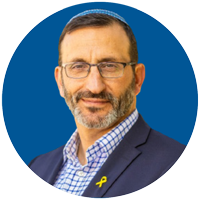
BY RABBI DORON PEREZ
This essay is an excerpt from “Days of Awe in Times of War” a newly published booklet by Rabbi Doron Perez. The booklets have been distributed together with HaMizrachi magazine.
To read a digital copy, click here.
There is one element of free choice that no one can ever take away from us and that is our ability to choose our thoughts.
As much as we have free choice, others can take away from us almost every freedom. We can be forced into situations where there is nothing we can do. We can be gagged and bound, Heaven forbid, be rendered unable to speak or act. But no human being can ever force us to think something we don’t want to think. We have absolute free choice to choose our attitude in every given situation.
Viktor Frankl and the final human freedom
This is one of the great insights into the human condition that emerges from Viktor Frankl’s masterpiece, Man’s Search for Meaning. Frankl writes that no one can tell him as a survivor of the concentration camps that a human being does not have free choice. He says that he witnessed people in their last moments stealing another person’s piece of bread in order to survive. Yet, incredibly he witnessed others who literally give away their last piece of bread. This, he maintains, provides unequivocal evidence of a human being’s capacity to choose a course of action even in impossible circumstances. He says that whether we become angels or animals, saints or sinners, it is entirely up to us.1 Indeed our sages have famously said that “everything is in the hands of Heaven except for the fear of Heaven.” This has been interpreted by many of our great ethicists to mean that everything that happens to us can be beyond our choice and control except our “fear of Heaven”2 – how we choose to react to what happens to us.
So many circumstances, as we know all too well, happen without us having any choice or control – they are forced upon us. But one thing can never be taken away and that is our fear of Heaven. We can always choose our attitude.
When we face challenges in life that shake our world, we have to dig very deeply into our reservoirs of faith and perspective. Vulnerability and excruciating pain need not necessarily beget paralysis or anger, blame or harsh criticism – there is nothing automatic about these responses. As Stephen Covey has said in his The 7 Habits of Highly Effective People: between stimulus and response there is a gap and we live in that gap.3 The things that happen to us – stimuli – need not elicit any automatic uncontrolled response. We have free choice to dig deep within ourselves and to choose our perspective on what happens to us and then to choose our attitude, response, and course of action. To try, despite the pain, to choose a path of hope and healing, light and life. Faith and beliefs impact perception which in turn impact our actions and performance. We indeed see the world not the way it is but the way we are.
My mental gamble and ‘hostage deal’ with myself
Having gone through the horrific 163 days of our son being a hostage and thought to be alive, we were full of fear and angst – amongst the most harrowing situations in life. This tested us in a way that nothing previously had. Then, the knowledge that Daniel had been murdered, with his lifeless body held somewhere in Gaza. Just to find the strength to live each day by putting one foot in front of the other required all our inner reserves of strength and resilience to somehow face the valley of death with faith, hope, and positivity. There is a need every day to choose how to confront this challenging reality.
I felt this so acutely, particularly during those 163 painful days. How is one to cope with the knowledge that one’s son is being held by Hamas and heaven only knows what they are undergoing? Are they, G-d forbid, being tortured? Is he injured or even alive? When and will we see him again? How is one to handle such impossible thoughts about the fate of one’s beloved child? I realized very quickly that if I am unable to be intentional and proactive about my thoughts, they will get the better of me, paralyze and destroy me.
I needed to up my game and do everything I could to think correctly and create the mental paradigm that I wanted to try to live in. I, thankfully, with the grace of G-d, was able to develop the following mind game that I played with myself each and every day. I said to myself as follows: There is a chance that Daniel did not survive the first day of the tank battle and that would mean, G-d forbid, that he is no longer alive. If that is the case, that means I have nothing to worry about – he is not being tortured. They cannot harm him. If it is true that, G-d forbid, he is deceased, then I have a lifetime of loss and mourning to contend with. But I need not worry about that at all now, because hopefully he is alive. If on the other hand, he is alive, then please G-d, we have so much hope and we will, b’ezrat Hashem [with G-d’s help], see him again.
The choice to view reality as the glass half-full is our choice, and our choice alone. It is possible to see the emptiness and pain of both sides of the equation, that he is, G-d forbid, either dead or being tortured. But one can choose to do one’s best to think differently – that if he is alive, we will, please G-d, see him again. And if, G-d forbid, he has died, then he is not in harm’s way and has died al kiddush Hashem [lit. for the sanctification of G-d, as a holy martyr].
This is a choice, an almost impossible one. I have come to believe that Hashem gives us seemingly impossible tests to face. Yet, somehow, at the same time, He gives us impossible strength to deal with them.
Rosh Hashanah – head of the year
This is exactly the spiritual focus of Rosh Hashanah – the first of the Days of Teshuva, expressed in the very name of this festival. The Hebrew word our sages have chosen for the New Year is Rosh Hashanah – the “Head of the Year” – and not the more obvious term Reishit Hashanah, the “Beginning of the Year.”4
The reason our sages picked this specific term – the head – is because the head and mind are the keys to understanding the essence of the day.
Rosh Hashanah is a time of deep cognitive reflection – not a time of action. We examine our spiritual and mental paradigms and thought processes in preparation for the year ahead. It’s a time for big-picture mind-mapping – not meddling in minutiae, in specific actions. It is, for this reason, we remarkably do not focus whatsoever on individual actions nor any mention of sin or confession throughout the lengthy prayer service. Although part of the essence of teshuva is confession5 as we do throughout the selichot prayers of penitence and hundreds of times throughout Yom Kippur – we astoundingly do not utter one word of confession on Rosh Hashanah! We dare not get lost in the detail, lest we fail to distinguish the woods from the trees. It’s not time “to rearrange deck chairs on the Titanic,” but rather to ensure that we are heading in the right direction. Rosh Hashanah is an intense exercise in systematic strategic spiritual thinking.
It is a time to challenge the very way we see the world. Just as “seeing is believing” so too “believing is seeing” – what we think and believe causes us to see our reality in a certain way. If we cannot conceive of ourselves differently then we cannot chart a different course of action. How we examine ourselves in thought on Rosh Hashanah will determine the type of atonement in action on Yom Kippur. Rosh Hashanah is a day when we create in thought the conceptual reality for the world we choose to live in.6
1 Man’s Search for Meaning, Viktor Frankl, pp. 65–66.
2 Berachot 33b, Megillah 25a, Niddah 16b.
3 The 7 Habits of Highly Effective People: Restoring the Character Ethic, Stephen R. Covey, p.70.
4 Reishit is the obvious word as it is not only the first word in the Torah – Bereishit (“In the beginning”) – but it is also mentioned in Devarim [Deuteronomy] (11:12) as “the beginning of the year” – Reishit Hashanah. It is from here the Talmud (Rosh Hashanah 17b) learns the concept of annual judgment on Rosh Hashanah. Nevertheless, our sages chose Rosh Hashanah as the name of the festival and the Talmudic tractate.
5 Rambam in his introduction to the Laws of Teshuva sees the source of the mitzvah of teshuva in וִידוּי – confession.
6 Clear support for this perspective of Rosh Hashanah can be found in the writing of Rabbeinu Tam of the Ba’alei HaTosafot. He states that the world was created in thought in Tishrei and physically in Nissan (Rosh Hashanah 27a). This is how he resolves the discrepancy between both Tishrei and Nissan being times of creation according to our Talmudic sages (Rosh Hashanah 10). First the world is created in thought, a vision of the world – its ideal potential. Thereafter, in Nissan, it is created in reality. Clearly, the focus of Rosh Hashanah is therefore in the realm of thought. Just as the world was created in thought and potential, so too the service of the day is one of thought – to create the conceptual reality of our world.
Rabbi Doron Perez is the Executive Chairman of World Mizrachi.